
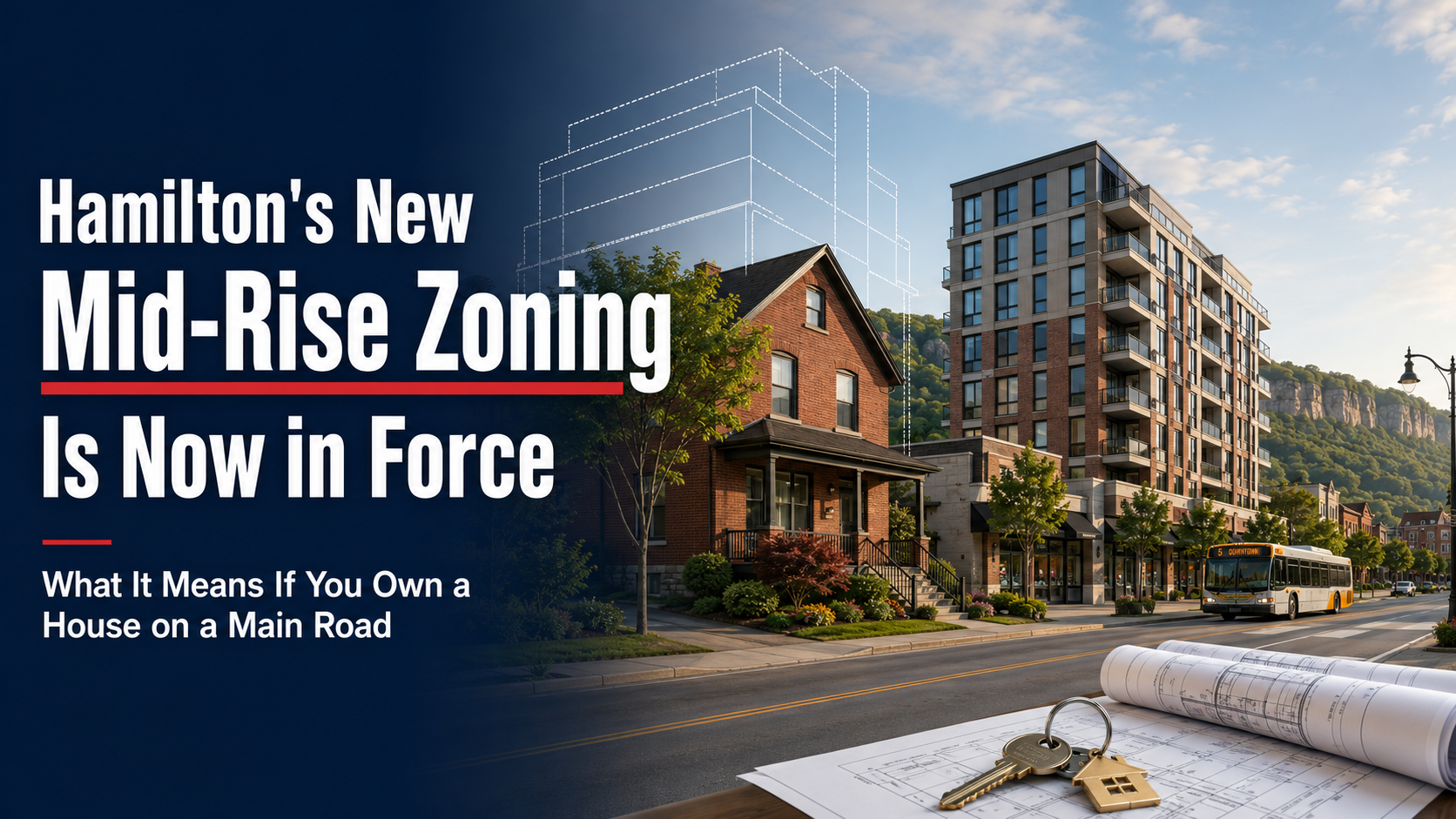
Hamilton's New Mid-Rise Zoning Is Now in Force: What It Means If You Own a House on a Main Road
Written by Daniel Zareh, REALTOR® — licensed since 2006, serving Hamilton, Stoney Creek, Winona and Grimsby.
Last reviewed 8 September 2026. Zoning details verified against City of Hamilton By-law 05-200.
On August 11, 2026, Hamilton's city-wide mid-rise residential zoning came into force. Council passed it back in October 2025, but it had been sitting at the Ontario Land Tribunal since then. The tribunal cleared it, and it is now the law across the city.
In plain terms: along most of Hamilton's main roads, apartment and townhouse density is now permitted as-of-right. As-of-right means a builder does not have to apply for a rezoning and sit through a year of hearings. The permission is already written into the by-law. The higher densities sit at the major intersections, with lower mid-rise density along the residential stretches in between.
If you own a house on a main road in Hamilton, something about your property did change. What probably did not change is what it's worth this month. I want to be clear about both halves of that, because I've already had homeowners ask whether they should hold off listing and wait for a builder to come knocking. For most of them, the honest answer is no.
➤ Search Hamilton homes on the live map
What the by-law actually allows
This is Phase 2 of the city's Residential Zones Project. Phase 1, back in 2022, dealt with low-density neighbourhoods. Phase 2 is the mid-rise piece, and it created three new zones.
The mid-rise residential zone — the one applied along arterial streets across the city — permits multiple dwellings up to 22.0 metres, which works out to roughly seven storeys depending on the build, and townhouse forms up to 13.5 metres. Front setback is 4.5 metres, dropping to 3.0 metres on designated lots. Side setback is 4.5 metres. Rear setback is 7.5 metres, and 10.0 metres for the part of a building above 14 metres. It also permits ground-floor commercial uses: retail, restaurant, office, personal service, child care, artist studio.
There's a large-scale mid-rise zone as well, which goes higher again. The draft zone text put the ceiling at 40.0 metres with a minimum lot frontage of 30.0 metres. I'd confirm the final numbers with the city before relying on them, but the frontage requirement is the part that matters here, and I'll come back to it.
One property is still under appeal — 752 and 756 West 5th Street. Everything else is in force. (Source: City of Hamilton Zoning By-law 05-200, Section 15; The Public Record, August 19, 2026.)
The market this lands in
Before anyone gets excited about a zoning map, it's worth knowing what the resale market underneath it is doing. Hamilton in July 2026: new listings down 19.6% year over year, sales down 4.7%, median sold price down 4.6%. Those are sold prices, not asking prices.
The short version is that fewer people are listing, buyers mostly stayed, and prices have drifted down. Supply is tighter than a year ago, but not because demand came roaring back. Sellers left. I broke the full month down by property type and neighbourhood in my Hamilton seller market update, so I won't repeat all of it here.
The honest read for homeowners
Here's what I keep telling people, and it isn't what they want to hear.
Your lot is probably too narrow on its own. A typical Hamilton residential lot on a main road runs 30 to 45 feet of frontage — roughly 9 to 14 metres. Take a 12-metre lot and subtract the 4.5-metre side setback off each side, and you're left with about 3 metres of buildable width. The height permission is real. The envelope on a single lot usually isn't. The large-scale zone, which is where the bigger numbers live, needs frontage most single lots don't have.
Which means assembly is where the value is. The properties that get a genuine land-value bid are the ones a builder can combine with the neighbours — three or four lots in a row, or a corner with depth. If you're in the middle of a block where two of your neighbours are also open to selling, you're in a different conversation than someone selling one house alone. That conversation is worth having together, not separately, and it moves slowly. Assemblies take years, not weekends.
Builders are not paying retail right now. Developers price land backwards from what they can sell the finished units for, and those numbers came down. Hamilton condominium average sold prices fell 11.3% year over year in July 2026, to $384,828. A builder pricing an apartment project on a main-road site is working off that number, not off 2022. If you're waiting for a land offer to rescue a price the resale market won't support, you may be waiting a long time.
What did change is who your buyer pool includes. Before this by-law, a small builder looking at your property had to price in the risk and the time of a rezoning application. Now they don't. That takes real cost and real uncertainty out of the calculation, and it widens the field of people who might look at your house as something other than a house. That is a genuine change. It's just a change that shows up over years, in specific locations, not as a citywide bump next Tuesday.
Whether your property is actually in it
The by-law applies along arterial roads across the city rather than neighbourhood by neighbourhood — lower city, Mountain, Stoney Creek, all potentially in scope. I'm deliberately not going to list streets here. The zone boundaries follow the by-law schedules, and being on a busy road is not the same thing as being in the zone. The only way to know about your property is to check your address against the mapping, or call the city's planning department and ask.
What I can tell you is what builders look at first. Corners, and lots with real depth behind them. Depth matters more than most owners expect, because rear setback requirements eat into shallow properties fast. If your lot is 100 feet deep on a main road, that's worth knowing. If it's 200, that's a different property.
This also stacks with the city's development charge decision earlier this year, which I covered in my post on Hamilton eliminating development charges on new homes. Cheaper to build and easier to get approved is a meaningfully different equation for a builder than it was eighteen months ago.
If you want to see how this goes in a city where the permission isn't as-of-right, look at what Burlington just did on Plains Road. Council approved an eight-storey and an eleven-storey there in September and refused a twenty-five-storey outright. Different city, different by-law, same lesson for a homeowner — what gets approved is consistently smaller than what gets proposed, and that's the number worth planning around.
Common Questions
Does the new Hamilton zoning increase my property value?
For most homeowners, not by a measurable amount today. It increases the value of assembled land in specific corridor locations over time. A single 35-foot lot on a main road is still worth roughly what a homeowner will pay for it, because a builder can't do much with it alone.
What does "as-of-right" actually mean?
It means the use is already permitted in the by-law, so a builder can apply for a building permit without first applying to rezone the property. They still need site plan approval and permits. It removes a step that used to cost a year or more and could fail entirely.
How do I find out what my property is now zoned?
Check your address against Zoning By-law 05-200 on the City of Hamilton website, or call the city's planning department. Do not assume you're in a mid-rise zone because you're on a busy street. The zone boundaries follow the by-law schedules, not your intuition about traffic.
Should I sell to a builder or list on MLS®?
Almost always list, unless you've had a real, specific approach from a builder who is already assembling around you. Builder offers on single lots tend to come in below what an end user will pay, because the builder is buying land and the homeowner is buying a home. Test the open market first.
Do I need my neighbours to sell at the same time?
For an assembly, yes, and that's the hard part. Three owners agreeing on price and timing is a negotiation on its own. If you're thinking about it, start the conversation with the neighbours before you start it with a builder — otherwise the builder controls the information and you don't.
Is this a bad time to sell in Hamilton?
It's a softer market with much less competition than usual, which cuts both ways. New listings were down 19.6% in July 2026, so there's less to compete against. The median sold price was down 4.6%, so you need to be realistic about where you start. At the end of the day, priced correctly, houses are still selling. The ones that sit are the ones priced off 2022 numbers.
➤ Search Hamilton homes on the live map
Keep reading
- Hamilton homes for sale — live listings, market data and neighbourhood guide
- Hamilton sellers — the city average fell, but your area probably didn't
- Hamilton eliminated development charges — what it changes for builders and buyers
- Burlington's Plains Road decisions — what a council actually approves on a corridor
- What's your home worth — how I actually run a valuation
- What Canada's steel counter-tariffs actually mean if you own a home in Hamilton
- Hamilton's second suite rules — what your lot already allows, and the September 28 deadline
Daniel Zareh is a licensed REALTOR® with over 20 years of experience serving Hamilton, Stoney Creek, Grimsby, Burlington, Oakville and Mississauga. Market figures cited are for July 2026 and change monthly.
Is your property actually affected by the new zoning?
The by-law schedules are not something most people want to read, and being on a busy road is not the same as being in the zone. Send me your address and I'll check what it's zoned for now, what your frontage and depth actually allow, and whether the land story is real in your location or just a headline.
If the honest answer is that the zoning changes nothing for you and your best move is to list it as a house, I'll tell you that and show you what it would sell for on the open market instead.
Call or text 416-276-0052 Email: daniel@zarehhomes.com
Or send me your address below and I'll check it.
Is your property actually in the mid-rise zone?
Being on a busy road isn't the same as being in the zone, and the by-law schedules aren't something anyone wants to read. Send me your address and I'll check what it's zoned for now, what your frontage and depth actually allow, and whether the land story is real where you are. If the zoning changes nothing for you and your best move is to list it as a house, I'll tell you that and show you what it'd sell for.