
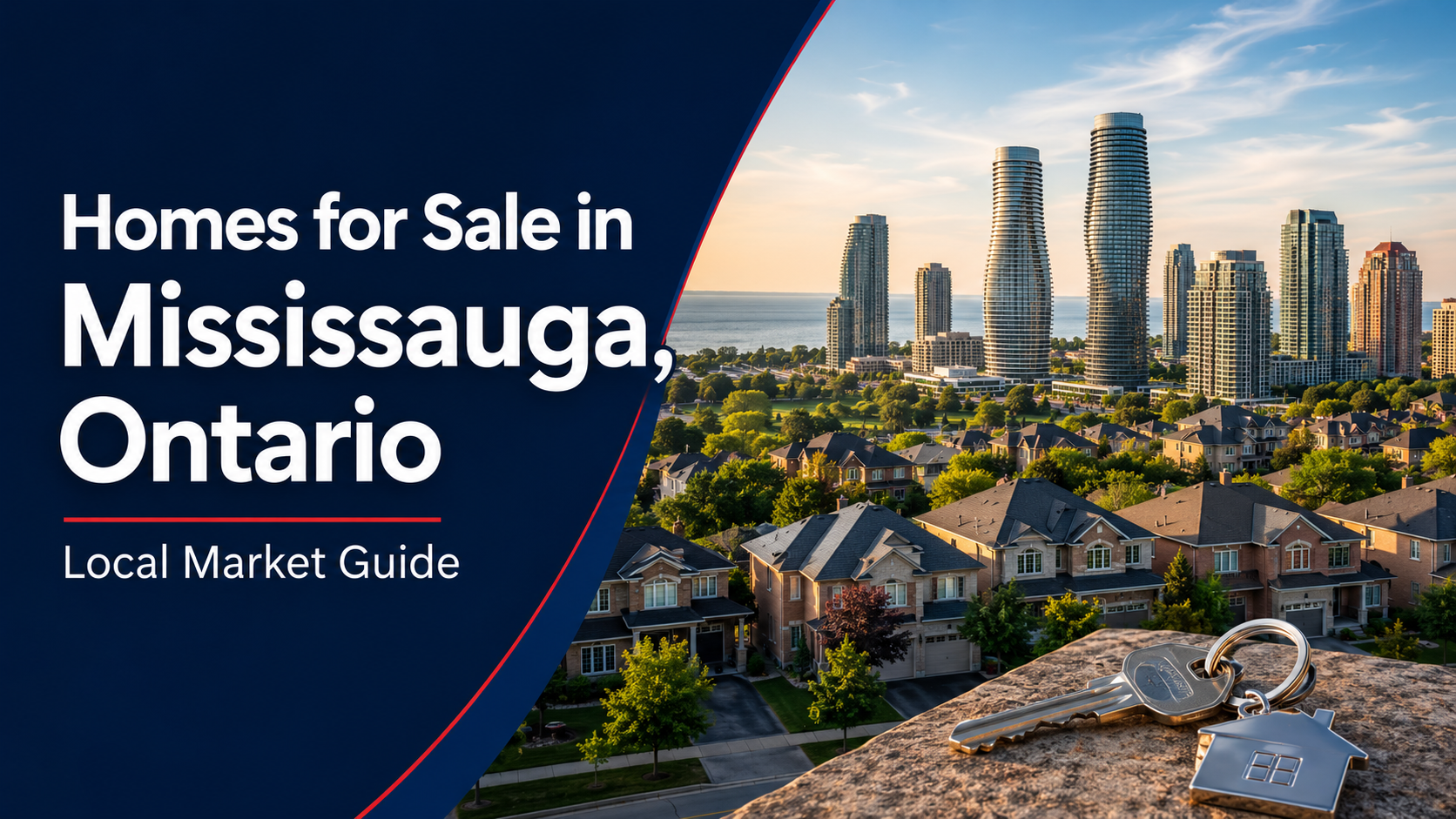
Homes for Sale in Mississauga, Ontario
If you're looking at homes for sale in Mississauga, you're looking at a city that behaves like six or seven different markets at once. Port Credit and Lorne Park have almost nothing in common with Square One, and Streetsville feels nothing like Malton. Mississauga rewards buyers who get specific about where they want to be, and frustrates the ones who shop the whole city at once.
➤ Search Mississauga homes on the live map
Here's a straightforward look at what buyers should know about the Mississauga real estate market right now.
What Kind of Homes Are Available in Mississauga
The city has the widest range of housing of anywhere I work:
- Detached homes — from the premium south-end streets in Lorne Park and Mineola, to established family neighbourhoods in Erin Mills, Meadowvale and Churchill Meadows, to more affordable stock in Cooksville, Applewood and Malton.
- Townhomes and freehold townhouses — spread throughout, with concentrations in Churchill Meadows, Erin Mills and Heartland. Usually the realistic entry point for families who need three bedrooms.
- Condos — Mississauga has one of the largest condo markets outside Toronto, centred on Square One and the City Centre, with older stock along Hurontario and newer buildings in Port Credit and along Lakeshore.
Mississauga Neighbourhoods, Pocket by Pocket
This is the part that matters most in Mississauga, because the city average tells you almost nothing about any specific street.
Port Credit — The marina, the Credit River and a real main street. Older detached homes on deep lots mixed with newer waterfront condo buildings, plus the Brightwater redevelopment reshaping the west side. Premium pricing, and the strongest lifestyle draw in the city.
Lorne Park and Mineola — Mississauga's most expensive detached pockets. Large treed lots, custom builds and rebuilds, top-end school catchments. Mineola in particular has seen a long run of teardown-and-rebuild activity.
Clarkson and Lakeview — The southwest and southeast corners. Clarkson has its own GO station and a quieter village feel; Lakeview is the one to watch, with a major waterfront redevelopment underway that will change the whole area over the next decade.
Cooksville and City Centre — The dense middle of the city around Square One and Hurontario. Overwhelmingly condo territory, with the deepest inventory and the widest price range in Mississauga. Cooksville also still holds older, more affordable detached stock.
Erin Mills and Central Erin Mills — West-central Mississauga around Erin Mills Town Centre and John Fraser / Gonzaga school catchments. One of the most consistently in-demand family areas in the city, and the pocket where school catchment drives pricing hardest.
Churchill Meadows — Newer detached and freehold townhouse stock in the far west. Popular with families moving up from a condo who want a modern layout without going to Milton.
Streetsville — A historic village core that Mississauga grew around. Main street shops, a GO station on the Milton line, and a mix of older character homes and newer infill. Distinctive in a way most of the city isn't.
Meadowvale and Heartland — Northwest Mississauga. Established family neighbourhoods, plenty of townhouse stock, and close to the Heartland employment lands and the 401/407 interchange.
Applewood, Dixie and Rathwood — East Mississauga toward the Etobicoke border. Some of the best value detached homes in the city, mature lots, and quick access to the QEW and downtown Toronto.
Malton — The northeast corner by the airport. The most affordable entry point into Mississauga freehold, and a practical option for buyers working at or around Pearson.
What Homes Actually Cost in Mississauga
As of July 2026, Mississauga's average sold price across all property types was about $899,000, with the MLS benchmark — the value of a typical Mississauga home — at roughly $880,000.
By property type, average sold prices looked like this:
- Detached: around $1,257,000
- Semi-detached: around $892,000
- Townhouse: around $912,000
- Condo apartment: around $512,000
A couple of things stand out. The average and the benchmark are unusually close here — about $19,000 apart, against roughly $195,000 in Burlington. That tells you Mississauga's market is broad and evenly distributed rather than being pulled around by a small number of luxury sales. It's a more predictable market to price in.
The other thing: at around $512,000, the condo average is the lowest of any market I work in, and there's real depth behind it. If you want genuine choice at an entry-level price point in the western GTA, this is where it exists. Burlington's condo average sits roughly $125,000 higher and Oakville's about the same.
Worth noting that townhouses average slightly above semi-detached here. That's a mix effect — a lot of the townhouse stock is newer and further west, while the semi stock skews older and more central.
Why Buyers Are Looking at Mississauga
The pull here is different from Burlington or Oakville:
The Hurontario LRT. This is the biggest infrastructure story in the city. Transit lines change the value of the land around them, slowly and then all at once, and the Hurontario corridor is the clearest example of that in the western GTA right now.
Two GO lines and the airport. Port Credit and Clarkson on the Lakeshore West line, Streetsville and Meadowvale on the Milton line, and Pearson on the doorstep. For anyone who travels for work, Mississauga is hard to beat.
Port Credit. The marina, the Credit River, the main street — it's the closest thing the western GTA has to a lakeside town inside a major city, and the Lakeview and Brightwater redevelopments are still reshaping that whole shoreline.
Real condo inventory. If you want a one or two bedroom with actual choice at your price point, Mississauga has depth that Burlington and Oakville simply don't.
Getting Around and Commuting from Mississauga
Mississauga has the most transit options of any market I work in, and which one you're near should shape where you buy.
- Port Credit GO — roughly 20–30 minutes to Union on the Lakeshore West line. The fastest commute available from anywhere in this guide.
- Clarkson GO — roughly 25–35 minutes to Union, with large parking capacity.
- Cooksville, Erindale, Streetsville and Meadowvale GO — on the Milton line, roughly 30–45 minutes to Union. Milton line service is less frequent than Lakeshore West, which is worth checking against your actual schedule before you commit to a neighbourhood.
- Hurontario LRT — running up the Hurontario corridor and connecting into the GO network, tying the City Centre to Port Credit and Brampton.
By car, Pearson is 15–20 minutes from most of the city, downtown Toronto is 30–45 depending on traffic and the 401, 403, 407, QEW and 410 all run through. Oakville is about 20 minutes west.
Who Should Be Looking Here
Mississauga works well for first-time buyers who need a condo or townhouse with genuine selection, families who want a detached home with GTA access without Toronto pricing, and investors — the combination of transit expansion, rental demand near Square One and UTM, and a deep condo market is the strongest investment case in any of my markets.
Parking is worth flagging for investors specifically. On a two-bedroom condo it materially affects both what you can charge and how fast you lease. Skip it and you narrow your tenant pool more than the price saving justifies.
Common Questions About Buying in Mississauga
What is the average home price in Mississauga?
About $899,000 across all property types as of July 2026, with the benchmark price for a typical home around $880,000. Detached homes average close to $1,257,000 and condos around $512,000.
Is Mississauga cheaper than Oakville or Burlington?
Yes. Mississauga's overall average is roughly $150,000 below Burlington's and about $514,000 below Oakville's. The condo gap is the widest — Mississauga condos average significantly less than either, with far more inventory to choose from.
Which Mississauga neighbourhood is best for families?
Erin Mills and Central Erin Mills get the most family demand, largely on school catchment. Churchill Meadows and Meadowvale are the usual choices for newer housing stock, and Streetsville for buyers who want a village feel.
Is Mississauga good for investors?
It's the strongest investment case of any market I work in — deep condo inventory, steady rental demand around Square One and UTM, and the Hurontario LRT reshaping the corridor. Just don't skip parking on a two-bedroom.
How long is the commute from Mississauga to Toronto?
From Port Credit GO, roughly 20–30 minutes to Union. From the Milton line stations, closer to 30–45 with less frequent service. Driving is typically 30–45 minutes off-peak and considerably longer at rush hour.
What's the cheapest way into the Mississauga market?
Condo apartments along the Hurontario corridor and around Cooksville, where older stock trades well below the newer City Centre buildings. For freehold, Malton is the lowest entry point in the city.
See What's Available Right Now
Listings change daily. The live map shows every active Mississauga listing straight from MLS — filter by price, home type and neighbourhood, and save the searches you want to keep an eye on.
➤ Browse all Mississauga listings
Comparing markets? I've put together the same breakdown for Oakville, Burlington and Stoney Creek.
Thinking About Buying in Mississauga?
Mississauga is a city where picking the right neighbourhood does more for you than picking the right house. If you want to go through current listings, pricing, rental numbers, or which parts of the city actually fit what you're after, send me your budget and I'll tell you which neighbourhoods I'd actually look at and which I'd skip.
Keep reading
- Oakville homes: pockets, prices and what to watch
- The money side of buying: credit, mortgages and the costs nobody mentions
- Pre-construction condos in downtown Hamilton, from the $250s
Call: 416-276-0052 Email: daniel@zarehhomes.com
Daniel Zareh is a licensed REALTOR® with over 20 years of experience serving Mississauga, Oakville, Burlington, Hamilton, Stoney Creek and Grimsby. Market figures cited are for July 2026 and change monthly.
Have questions?
Want to know more about Homes for Sale in Mississauga, Ontario — Local Market Guide? Send me a message and I'll get back to you within 24 hours.