
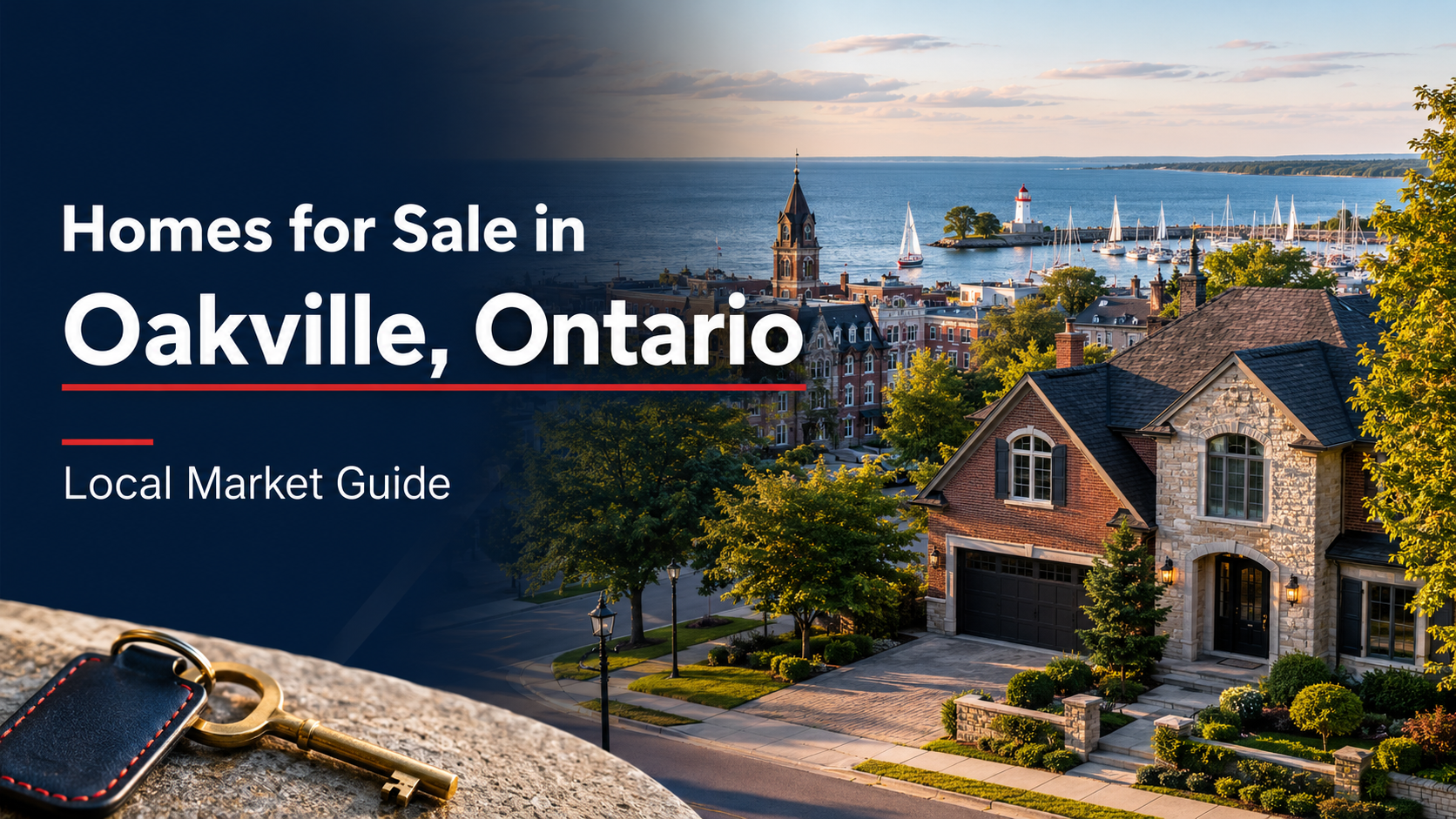
Homes for Sale in Oakville, Ontario
If you're looking at homes for sale in Oakville, you're looking at one of the strongest-holding markets between Toronto and Hamilton. Oakville runs from the lake up past Dundas Street into the newer north end, and it's a town where the difference between two neighbourhoods a few minutes apart can be several hundred thousand dollars. Understanding those lines is most of the work.
➤ Search Oakville homes on the live map
Here's a straightforward look at what buyers should know about the Oakville real estate market right now.
What Kind of Homes Are Available in Oakville
Oakville splits fairly cleanly between the older south end and the newer north:
- Detached homes — Old Oakville and Bronte for character homes and lake proximity, Glen Abbey and River Oaks for established family streets, and Joshua Creek, Preserve and north Oakville for newer builds with modern layouts.
- Townhomes and freehold townhouses — the practical entry point into Oakville, with most of the newer stock in Uptown Core, West Oak Trails and the Palermo area.
- Condos — clustered around Uptown Core, Kerr Village and downtown, plus a growing number of newer buildings along Dundas as the north end has filled in.
Oakville Neighbourhoods, Pocket by Pocket
In Oakville the neighbourhood does more work than almost anything on the listing sheet. Here's the practical map:
Old Oakville — South of Lakeshore around the harbour. Century homes, custom rebuilds, mature trees and the shortest walk to downtown and the water. The most expensive pocket in town, and the one that holds value best when the market softens.
Bronte — The southwest corner around Bronte Harbour. A genuine village feel, a working marina, and a mix of older bungalows, rebuilds and newer condo buildings on the water. More relaxed than Old Oakville and usually somewhat more attainable.
Kerr Village — Just north and west of downtown. One of the few south Oakville pockets where entry-level product still exists, with older detached homes, semis and smaller condo buildings. A steady renovation and infill market.
Glen Abbey — Built around the golf course, west of Bronte Road. Mature family streets, strong schools including Abbey Park, and a lot of original owners finally turning over. Consistently one of the most searched neighbourhoods in Oakville.
River Oaks and College Park — Central Oakville north of the QEW. Established homes from the 70s through 90s, close to Sheridan College, the Oakville Trafalgar hospital corridor and good transit. Reliable family demand and a wide price range.
Clearview and Iroquois Ridge — East Oakville toward the Mississauga border. Iroquois Ridge North in particular draws buyers specifically for the school catchment, and that demand shows up in pricing.
Joshua Creek — Northeast Oakville, largely built in the 90s and 2000s. Larger detached homes, quiet crescents, and one of the more sought-after family pockets for people moving up from Mississauga.
West Oak Trails and Palermo — West of Bronte Road, north of the QEW. Newer detached and freehold townhouse stock, close to the hospital and the 407. A common landing spot for first-time Oakville buyers.
Uptown Core — Around Trafalgar and Dundas. The densest part of Oakville — condos, stacked towns and retail all together. If you want an Oakville address at the lowest possible entry point, this is usually it.
North Oakville — Preserve, Glenorchy and Trafalgar — Everything above Dundas, and still filling in. The newest housing stock in town, modern layouts, new schools, and the pocket most likely to have pre-construction and assignment inventory available.
What Homes Actually Cost in Oakville
Oakville is the most expensive market I work in, and the numbers are worth seeing plainly. As of July 2026, the average sold price across all property types was about $1,413,000, with the MLS benchmark — the value of a typical Oakville home — at roughly $1,152,000.
By property type, average sold prices looked like this:
- Detached: around $1,904,000
- Semi-detached: around $1,085,000
- Townhouse: around $1,057,000
- Condo apartment: around $637,000
The gap between detached and everything else is the story here. In most markets a townhouse is a step down from detached; in Oakville it's closer to a different market entirely — roughly $850,000 separates the two averages. That gap is exactly why so many Oakville searches end in a townhouse or a condo in the north end rather than the detached home people started out looking for.
Worth knowing: the condo average is the one number that makes Oakville look affordable, and it's misleading on its own. Much of that stock is older and smaller. Newer buildings in Uptown Core and on the water in Bronte sit well above it.
Why Buyers Are Looking at Oakville
The reasons buyers give me for Oakville are consistent, and they're mostly not about the houses:
The schools. This is the number one driver, full stop. Oakville Trafalgar, Abbey Park and Iroquois Ridge catchments move prices on their own, and plenty of families buy a smaller house specifically to land inside one.
Two GO stations. Oakville and Bronte both sit on the Lakeshore West line, which makes downtown Toronto workable without living there. For a lot of buyers that single fact decides the town.
The harbours and the downtown. Oakville Harbour and Bronte Harbour give the south end a genuine waterfront-village feel, and Lakeshore Road downtown has held onto independent shops and restaurants in a way most suburbs haven't.
It holds value. Oakville has historically been one of the more resilient markets in the region through corrections. That matters more than people think when you're buying at the top of your budget.
Getting Around and Commuting from Oakville
Oakville's commute profile is the best of any market I work in, and it's priced accordingly.
- Oakville GO — roughly 30–40 minutes to Union on the Lakeshore West line, depending on express or all-stop service. One of the busiest stations on the line.
- Bronte GO — roughly 35–45 minutes to Union, and generally easier for parking than Oakville GO.
By car, Mississauga is about 20 minutes, Burlington about 15, and downtown Hamilton about 35 on the QEW. The 407 runs across the north end, which is a real advantage if your commute is to Vaughan, Markham or the airport rather than downtown.
One practical note: in the south end, walking distance to a GO station is a genuine pricing factor. It shows up in what homes sell for within about a ten-minute walk of Oakville and Bronte GO.
Who Should Be Looking Here
Oakville works best for families where school catchment is the deciding factor, buyers who commute into Toronto and want the GO line, and move-up buyers coming from Mississauga or Burlington who are trading square footage for location and long-term hold.
It's the most expensive market I work in, and I'll tell people that directly. If the budget is stretched, Burlington or north Oakville townhomes usually get you closer to the same schools and commute for meaningfully less than a detached home south of the QEW. If you're buying your first home, it's worth running the numbers honestly before you commit to the town.
Common Questions About Buying in Oakville
What is the average home price in Oakville?
About $1,413,000 across all property types as of July 2026, with the benchmark price for a typical home around $1,152,000. Detached homes average close to $1,904,000.
Why is Oakville so expensive?
Three things compounding: school catchments that draw families from across the GTA, two GO stations on the Lakeshore West line, and limited detached supply in the south end where demand is highest. None of those are changing quickly.
Which Oakville neighbourhood has the best schools?
Oakville Trafalgar, Abbey Park and Iroquois Ridge catchments get the most attention from buyers. Catchment boundaries do get reviewed, so confirm the current boundary for a specific address before you buy on that basis.
How long is the commute from Oakville to Toronto?
Roughly 30–40 minutes by GO train from Oakville GO to Union. It's one of the shortest commutes available from a town with this much detached housing.
What's the cheapest way into Oakville?
Condo apartments in Uptown Core and Kerr Village, and freehold townhouses in West Oak Trails and north Oakville. Kerr Village is also where the older, smaller detached stock still occasionally comes up.
Is Oakville or Burlington the better buy?
It depends on what you're optimising for. Oakville has the stronger schools and the faster commute; Burlington gives you noticeably more house for the money and a downtown a lot of people prefer. Based on what you're looking for, the answer changes — it's worth actually running both.
See What's Available Right Now
Listings change daily. The live map shows every active Oakville listing straight from MLS — filter by price, home type and neighbourhood, and save the searches you want to keep an eye on.
➤ Browse all Oakville listings
Comparing markets? I've put together the same breakdown for Burlington, Mississauga and Stoney Creek.
Thinking About Buying in Oakville?
In Oakville the catchment map and the street matter more than almost anything else on the listing. If you want to go through current listings, pricing, or which pockets of Oakville actually fit your budget and your school priorities, send me the budget and the schools and I'll tell you where I'd start.
Keep reading
- Buying in Burlington: what the market looks like
- The money side of buying: credit, mortgages and the costs nobody mentions
- The HST rebate on new homes, explained plainly
Call: 416-276-0052 Email: daniel@zarehhomes.com
Daniel Zareh is a licensed REALTOR® with over 20 years of experience serving Oakville, Burlington, Mississauga, Hamilton, Stoney Creek and Grimsby. Market figures cited are for July 2026 and change monthly.
Have questions?
Want to know more about Homes for Sale in Oakville, Ontario — Local Market Guide? Send me a message and I'll get back to you within 24 hours.